

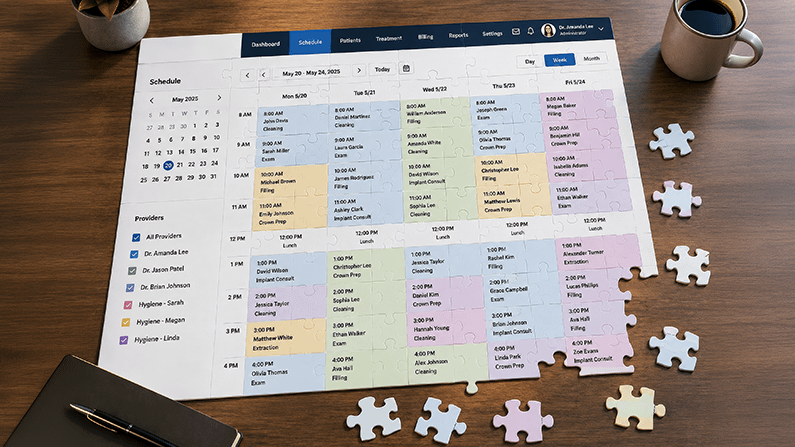
Two practices can see the same number of patients, employ the same size team, and work the same hours — and one will be calm and profitable while the other feels frantic and leaves money on the table. A surprising amount of that difference comes down to one unglamorous thing: how the schedule is built. The schedule is the operating system of the practice, and most are assembled reactively, one appointment at a time, in whatever slot happens to be open.
Block scheduling is the alternative — a deliberate approach that designs the day around your production goals and the practice’s real capacity instead of letting the calendar fill itself at random. Done well, it produces more with the same hours, smooths the flow of the day, and reduces the chaos that burns teams out. This guide explains what block scheduling actually is, why random scheduling costs you, and how to build a system that works.
What Block Scheduling Actually Is
Block scheduling means reserving specific times in the day for specific types of appointments, based on the production and flow you want, rather than booking whatever comes next into whatever slot is open. In practice, that means protecting time for the high-value procedures that drive production and arranging the rest of the day’s appointments around them intentionally.
The core idea is that not all appointments are equal in value or in their demands on the practice, so a day built by treating them as interchangeable will underperform a day built with intention. Block scheduling is simply the discipline of designing the day on purpose — deciding in advance what an ideal day looks like and then guiding booking toward that shape, instead of reconstructing a random day after the fact and hoping it works out.
Why Random Scheduling Quietly Costs You
When appointments are booked into whatever slot is open, the day organizes itself by accident. High-production procedures get scattered or crowded out by lower-value ones that happened to book first, the flow of the day lurches between overloaded and idle, and the team absorbs the resulting chaos. The practice ends up producing less than its capacity while feeling busier than ever — the worst of both worlds.
This is the hidden tax of reactive scheduling: it’s not that the practice isn’t working hard, it’s that the work isn’t arranged to produce its potential. Two days with identical appointment counts can differ dramatically in production and stress depending purely on how they were sequenced. Random scheduling leaves that difference to chance, which almost always means leaving production and calm on the table. (See how to protect the schedule from cancellations.)
Design the Day Around Production
The starting point for block scheduling is your production goal. If you know what you need the day to produce, you can work backward to the mix and timing of appointments that achieves it, and then protect the time for the procedures that carry the most weight. Rather than hoping high-value cases find room, you reserve room for them first and arrange everything else around that anchor.
This is the mindset shift at the heart of the system: the schedule serves the goal, not the other way around. When the day is designed around what you’re trying to produce, the high-value work has a guaranteed home, the supporting appointments fit around it, and the day’s output becomes something you engineer rather than something you discover at closing. It turns the schedule from a passive record into an active tool for hitting your numbers.
Protect Your Blocks (Or They Disappear)
Designing ideal blocks is the easy part. The hard part — and where most block scheduling fails — is protecting them. The moment a team feels pressure to “just fit someone in,” reserved blocks get filled with whatever’s convenient, and within weeks the system erodes back into random scheduling with extra steps. A block that isn’t protected isn’t a block; it’s a suggestion.
Protecting blocks requires a clear standard and a team that understands why it matters. Everyone booking appointments needs to know which times are reserved for what, and to hold that line even under the small daily pressures to break it. This is a discipline and training issue more than a software issue — the practices that succeed at block scheduling are the ones whose teams genuinely understand and defend the design, rather than treating it as a nice idea that yields the first time it’s inconvenient.
Balance Production With Patient Flow
A well-built block schedule isn’t only about production — it’s also about the experience of the day for patients and team. Blocks should account for the natural rhythm of the practice so that the day flows rather than lurching between overload and dead time. When high-demand and lower-demand appointments are sequenced thoughtfully, patients wait less, the team works at a steadier pace, and the whole operation feels more controlled.
That balance is part of the return on block scheduling that owners underrate. A day that produces well but leaves the team frazzled and patients waiting isn’t fully optimized. The goal is a schedule that hits production and feels calm — and those two goals reinforce each other, because a team that isn’t in constant firefighting mode delivers a better experience and converts more of the opportunities in front of them.
Common Block Scheduling Mistakes
- Building blocks but not protecting them. The design is only as good as the team’s willingness to hold the line under daily pressure.
- Designing around convenience instead of production goals. Blocks should be anchored to what the day needs to produce, not to what’s easiest to book.
- Making it too rigid to serve patients. A system that can’t flex for genuine emergencies or real patient needs will be abandoned; build in intentional flexibility.
- Never revisiting the design. Capacity, team, and demand change; a block schedule set once and never reviewed slowly drifts out of alignment.
Make It a Reviewed System
Block scheduling isn’t a one-time setup; it’s a system you build, protect, and periodically revisit. As the practice’s capacity, goals, and patient demand shift, the ideal shape of the day shifts with them, and the design should be reviewed so it keeps matching reality. A schedule template that made sense a year ago may be quietly costing production today.
Assign ownership of the schedule design to someone who watches how it’s actually performing against the practice’s goals and adjusts it deliberately. Like every durable improvement in a practice, an effective schedule is the product of a maintained system rather than a one-time fix — set with intention, defended daily, and tuned as the practice grows. (See how the morning huddle keeps the schedule on track.)
Frequently Asked Questions
Is block scheduling too rigid for a busy practice?
Not when it’s built well. Good block scheduling includes intentional flexibility for emergencies and real patient needs. The rigidity people fear comes from poorly designed systems; a thoughtful one guides the day toward your goals while still flexing when it genuinely needs to.
How do I start block scheduling without disrupting everything?
Start by protecting time for your highest-value procedures and building the rest of the day around them, then expand from there. You don’t have to redesign everything at once — anchoring the day’s most important work and defending that time is most of the benefit.
Why do block schedules break down?
Almost always because the blocks aren’t protected. Under daily pressure to “just fit someone in,” reserved time gets filled with whatever’s convenient and the system erodes. Success depends on a team that understands the design and holds the line consistently.
Who should own the schedule design?
A specific person who monitors how the schedule performs against production goals and adjusts it as the practice changes. Leaving the design to no one is how it drifts back into reactive, random booking over time.
Build the Day on Purpose
Your schedule is either working for you or working against you, and the difference is whether it was designed or just filled. Block scheduling is the discipline of building the day around your goals, protecting the time that matters, and revisiting the design as you grow. Do that, and the same hours and the same team quietly start producing more — with less chaos along the way.
Track Whether the Design Is Working
A block schedule isn’t finished when it’s built — it’s validated by whether the days actually produce and flow the way the design intended. That means watching the results: are the high-value blocks staying protected and filled, is the day’s production landing where you planned, is the team feeling the smoother rhythm the design was meant to create? These are answerable questions, and the answers tell you whether the schedule is delivering or quietly drifting.
Reviewing the design against real outcomes turns block scheduling from a hopeful template into a managed system. When something isn’t working — a block that never fills, a recurring bottleneck the design didn’t anticipate — you adjust deliberately rather than abandoning the approach. This feedback loop keeps the schedule aligned with the practice’s goals as capacity and demand change, and it’s the habit that separates practices that sustain the gains of block scheduling from those that let a good design slowly erode back into reactive booking.
Take the Free 5-Star Challenge
A designed schedule only pays off if the front desk is booking every opportunity that calls in. See how many your team is converting with a free, scored evaluation.
Take the Free 5-Star ChallengeAccelerate Your Practice Growth