

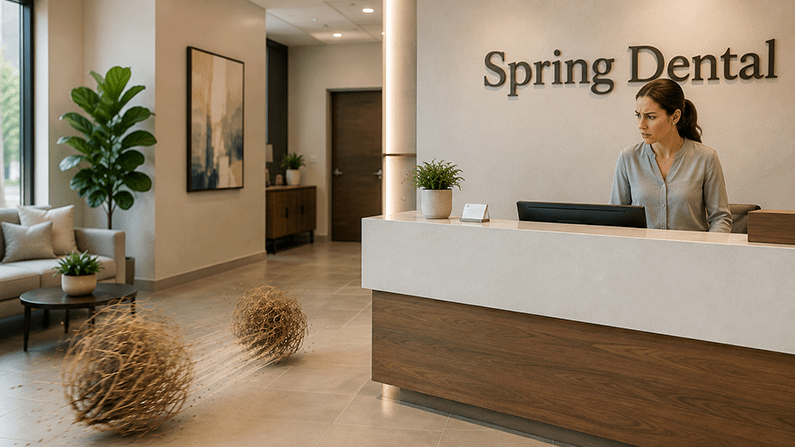
No-shows are the most expensive problem in a dental practice that most practice owners have accepted as normal. The schedule looks full. Patients confirm. And then, on the day of the appointment, gaps appear without warning. The overhead for that time slot was already committed—staff are there, the room is set up—but the production that was supposed to offset it never materializes.
Nearly 82% of dentists report that patient no-shows and cancellations are the largest factor preventing their schedule from reaching full capacity, according to Becker’s Dental Review. And the financial consequence is not small: a practice that loses one appointment per day over the course of a year loses between $20,000 and $70,000 in production, according to Dental Economics—revenue that was scheduled, prepared for, and simply didn’t arrive.
The good news is that no-shows are not random. They follow patterns. And the practices that have driven their no-show rates to near zero have done it not through better luck or better patients, but through better systems at the front desk. Here are the seven systems that work.
System #1: Confirm Appointments on a Defined Schedule—Not When You Remember
The most common front desk confirmation approach is inconsistent: calls go out when there’s time, texts when the software suggests it, and reminders are skipped when the desk is busy. The result is that some patients receive multiple confirmations and others receive none.
A high-performing confirmation system runs on a defined schedule with defined responsibility: a specific team member confirms appointments 48 hours in advance by phone, follows up by text if no answer is reached, and logs the confirmation status in the practice management system. Every appointment has a documented status—confirmed, unconfirmed, or standby. No appointment reaches the day of without that status being resolved.
The consistency of the confirmation protocol, more than the specific channel or timing, is what drives down no-show rates. Patients who hear from the practice expect the practice to hold them to the appointment. Patients who hear nothing treat their dental visit as optional.
System #2: Build a Same-Day Opening List That Gets Called—Not Texted
When appointments do cancel, the practices that recover production fastest are the ones with an organized, actively managed standby list. Not a passive list of patients who vaguely mentioned they were flexible—an actual database of patients who have been told “If we ever have a same-day opening, we’ll call you first. Would you like to be on that list?”
The key operational detail: the list gets called, not texted. Text messages produce lower same-day response rates than phone calls, and they’re easier to ignore. A team member who calls three or four patients from the standby list when a cancellation comes in fills the slot more often than one who sends a group text and waits. The two or three minutes it takes to make those calls is directly recoverable production. (See: the script every dental receptionist should know.)
System #3: Pre-Book Recare Appointments Before the Patient Leaves
Unconfirmed future appointments are no-show risks before they’re even scheduled. Patients who leave their hygiene appointment without a confirmed next visit have to re-engage with the practice six months later when the reminder arrives. That re-engagement has friction—and a meaningful percentage of patients don’t complete it.
The practices with the lowest no-show rates in their recare schedules pre-book the next appointment before the patient walks out the door. “Let’s go ahead and get you on the calendar—do you prefer mornings or afternoons in six months?” is a two-second question that eliminates an entire category of appointment attrition. The appointment that’s already on the calendar is dramatically more likely to be kept than one the patient has to actively re-initiate. (See: the front desk system that doubles new patients.)
System #4: Have a Clear Cancellation Policy—and Communicate It at Booking
Most practices have a cancellation policy they don’t consistently enforce because it was never clearly communicated at the time of booking. Patients who weren’t told about the policy can reasonably argue they didn’t know about it. Patients who were told, and who received a confirmation of the appointment that reiterated it, cannot.
The policy should be simple and human: “We ask for 24-hour notice if you need to reschedule, so we can offer that time to another patient who may be waiting. We’ll always do our best to work with you.” Communicating this warmly at booking—not as a legal disclaimer, but as a mutual expectation—changes the patient’s relationship to the appointment. It becomes a commitment, not a placeholder.
System #5: Reach the Patient the Way They Prefer to Be Reached
Confirmation calls that go to voicemail don’t confirm anything. Texts that patients have silenced don’t remind anyone. Email reminders that go to a rarely checked account disappear. The confirmation system that works is the one that actually reaches the patient.
At the time of booking, the most reliable confirmation channel for that specific patient should be noted: some patients prefer texts, others want a call, others respond best to an email. Front desk teams that gather communication preferences at scheduling and then honor them in their confirmation workflow see meaningfully higher response rates—and lower no-show rates—than teams that default to a single-channel approach regardless of patient preference.
48.3% of patients say they would want a call from the dentist a day prior to their appointment as a reminder, according to research on appointment nonattendance. The preference for a phone call is higher than most practices assume.
System #6: Make the No-Show Response a Reactivation Opportunity, Not a Loss
How the front desk responds to a no-show determines whether that patient comes back. A no-show call that communicates frustration—or silence, because the practice gave up—loses the patient. A no-show call that is warm, concerned, and solution-oriented recovers them.
“Hi, this is Name from Practice—we had you scheduled this morning and wanted to make sure everything was okay. We’d love to get you rescheduled when you have a chance—what does your week look like?” This framing does three things: it expresses genuine concern rather than administrative annoyance, it re-opens the scheduling conversation immediately, and it positions the practice as one that cares about the patient’s wellbeing.
Patients who receive this call and get rescheduled often become more loyal patients than those who never missed an appointment, because the recovery experience was notably positive. (See: why patient loyalty is the most underrated growth strategy.)
System #7: Track No-Show Rates as a Key Performance Metric
The practices that have driven no-show rates to near zero are the ones that track them. No-show rate by day, by provider, by appointment type, by team member handling confirmation—each of these data cuts reveals different opportunities. If one provider’s schedule has a consistently higher no-show rate, that’s information. If no-shows spike on Monday mornings, that’s information. If one team member’s confirmation calls produce a higher response rate than another’s, that’s information too.
You cannot manage what you don’t measure. No-show rates that are tracked, reported, and reviewed in team meetings create accountability for the confirmation systems and give the team concrete feedback on what’s working. Practices that track their no-show rate monthly see faster improvement than ones that address the problem episodically.
No-Shows Are a Systems Problem—Not a Patient Problem
The tendency in most practices is to attribute no-shows to the patient: they’re unreliable, they don’t value the appointment, there’s nothing you can do. The reality is that no-shows are largely a predictable outcome of confirmation systems that don’t work well—and they respond directly to systems that do.
We’ve worked with more than 11,000 practices on the front desk disciplines that reduce no-shows, increase confirmation rates, and recover same-day production gaps. The practices that have solved this problem have done it not through luck or better patients, but through better protocols applied consistently by a trained, accountable team.
No-shows are a problem with a solution. The solution is at the front desk.
Evaluate Where Your Practice Is Starting From
Before you can improve your no-show rate, you need a clear-eyed look at how your front desk is performing on the calls that start every patient relationship. That’s the same call quality that predicts confirmation success.
We’ll call your office as a new patient and evaluate how your front desk handles the conversation that determines whether every patient relationship starts—and continues—on the right foot.
Or book a call with our team. We’ll walk through your specific front desk challenges and show you what consistent performance looks like in a practice like yours.
And when a gap does open up, here’s how to fill last-minute cancellations fast.
Take the Free 5-Star Challenge
No-shows are downstream of how the appointment was originally scheduled. We’ll show you exactly where the scheduling conversation is leaking.
Take the Free 5-Star Challenge
Accelerate Your Practice Growth