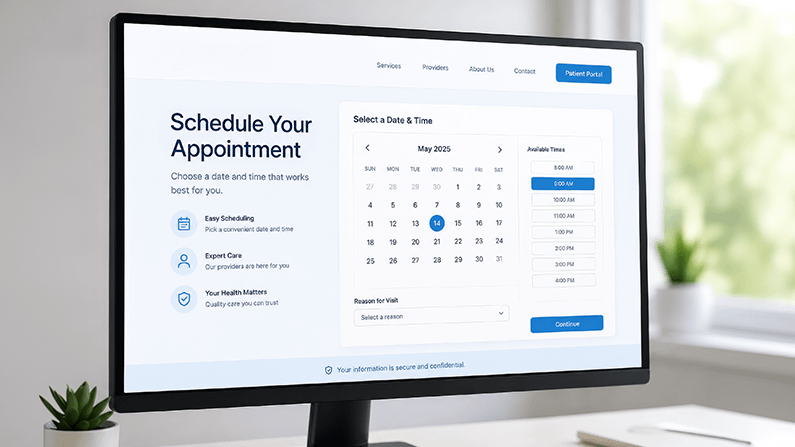
Online scheduling is one of those features patients increasingly expect and vendors relentlessly promote: let people book their own appointments anytime, cut the phone load, capture the after-hours patient who’d never call. The convenience is real, and for some practices it’s a genuine asset. But online scheduling also carries a risk that rarely makes it into the sales pitch — handled carelessly, it can quietly undermine the very things that make a schedule productive and a first impression strong.
The honest answer to “help or headache?” is that it depends entirely on how it’s implemented. Bolted onto a practice with no guardrails, online scheduling can scatter your carefully designed day and replace your best conversion moment with a form. Integrated thoughtfully, it can capture demand you were losing while protecting the systems that matter. This guide walks through both sides so you can decide how — and whether — to use it in a way that helps.
Why Patients Want It
The demand for online scheduling is real and worth respecting. Many patients, especially younger ones, simply prefer to book without a phone call, and a meaningful share of appointment intent happens outside business hours — evenings and weekends when your phones are dark. A patient motivated to book at 9 p.m. may not still be motivated at 9 a.m. when they’d have to call, so a booking option in that moment can capture demand that would otherwise evaporate.
Ignoring this preference has a cost. A practice that offers no way to book except calling during business hours is invisible to the patient who wanted to act after hours and moved on to an office that let them. So the case for online scheduling starts from a genuine truth: it can capture patients and intent you’re currently losing, and it meets a convenience expectation that’s only growing. The question is how to capture that upside without importing the downsides. (See how technology fits your patient flow.)
The Hidden Risk to Your Schedule
Here’s what the sales pitch omits: unrestricted online scheduling can quietly dismantle the intentional design of your day. If patients can book any open slot for any appointment type, your carefully protected blocks get filled at random — high-value time consumed by whatever books first, the flow of the day disrupted, the production logic you built undone. Online scheduling without guardrails is essentially random scheduling delegated to patients.
For a practice that has invested in block scheduling to shape its days around production goals, this is a serious risk. A tool sold as an efficiency gain can, unmanaged, erode the exact system that makes the schedule productive. The fix isn’t to avoid online scheduling — it’s to constrain it so patients can only book in ways that respect your design. But that requires understanding the risk before turning the feature on, which many practices don’t. (See how block scheduling protects production.)
The Cost to Your Best Conversion Moment
The phone isn’t just an administrative channel — it’s where a nervous new patient forms a first impression and a trained team converts them. When a practice pushes all scheduling online to reduce phone volume, it can inadvertently remove the human connection that turns a hesitant caller into a committed patient. A form doesn’t reassure an anxious first-timer, answer their real question, or build the trust that seals the booking.
This matters most for new patients, whose first contact carries the highest stakes and the greatest emotional weight. Routine, established-patient bookings may be perfectly suited to self-service, but funneling high-value new-patient contact into an impersonal form can cost conversions that never show up on any report. The goal is to use online scheduling where it helps without sacrificing the human touch exactly where that touch is worth the most. Segmenting who books online, and how, is central to getting this right.
Implement With Guardrails, Not Wide Open
The difference between help and headache is almost entirely in the guardrails. Thoughtful implementation means controlling what can be booked online and by whom — for example, allowing established patients to self-book routine visits into appropriate slots while ensuring new-patient and complex appointments still flow through your team, and constraining online bookings so they respect your block-scheduling design rather than overriding it.
Set up this way, online scheduling becomes a supplement that captures otherwise-lost demand without damaging your systems, rather than a wide-open door that lets convenience erode production and conversion. The work is in the configuration and the policy behind it — deciding deliberately how the tool fits your operation instead of accepting its defaults. Practices that succeed with online scheduling are the ones that made these choices on purpose; those that struggle usually just switched it on and hoped.
Measure Whether It’s Actually Helping
Once online scheduling is live, treat it as something to monitor rather than set and forget. Watch whether it’s capturing genuinely new demand or simply shifting bookings that would have happened anyway, whether it’s respecting your schedule design or quietly degrading it, and whether new-patient conversion is holding up or slipping. These are answerable questions, and the answers tell you whether to expand, constrain, or rethink the feature.
This measurement mindset keeps the tool serving the practice rather than the reverse. A feature that looked convenient can be quietly costing production or conversion, and only by watching the right indicators will you catch it. Conversely, evidence that it’s capturing real new patients without harming the schedule is the signal to lean in. As with any operational tool, the point is to manage it against outcomes, not to assume it’s helping because it’s modern. (See designing patient-facing systems intentionally.)
Common Online Scheduling Mistakes
- Turning it on wide open. Letting anyone book any slot for any appointment type hands your schedule design over to chance.
- Funneling new patients into a form. High-stakes first contacts lose the human touch that converts them.
- Ignoring block-scheduling protection. Unconstrained online booking overrides the production logic of your day.
- Never measuring the impact. Without monitoring, a tool that’s costing conversion or production goes unnoticed.
Make It Serve Your Systems
Online scheduling is neither savior nor saboteur — it’s a tool whose value depends on whether it’s configured to serve your systems or allowed to undermine them. Capture the after-hours and self-service demand it’s genuinely good at, protect your block schedule and your new-patient conversion with deliberate guardrails, and monitor the results so the tool keeps earning its place.
The broader principle holds here as everywhere: technology amplifies your systems rather than replacing them. A practice with strong scheduling design and phone conversion can add online booking as a smart supplement; a practice without those foundations can use it to scale its weaknesses. Decide on purpose, implement with guardrails, and let online scheduling be the help it can be rather than the headache it too often becomes.
Frequently Asked Questions
Should my dental practice offer online scheduling?
Often yes — but with guardrails. Patients increasingly expect it and it captures after-hours demand you may be losing. The key is constraining what can be booked online and by whom, so it supplements your systems rather than overriding your schedule design and new-patient conversion.
Can online scheduling hurt my practice?
Unmanaged, yes. Wide-open booking lets patients fill your protected blocks at random and funnels high-stakes new-patient contact into an impersonal form, costing production and conversion. The damage comes from careless implementation, not the concept itself.
Should new patients be able to book online?
Handle new-patient contact carefully. Their first interaction carries the highest stakes and emotional weight, and a trained human often converts them far better than a form. Many practices let established patients self-book routine visits while routing new and complex appointments through the team.
How do I know if online scheduling is helping?
Measure it. Watch whether it captures genuinely new demand, respects your schedule design, and preserves new-patient conversion. If those hold up, expand it; if they slip, constrain or rethink it. Treat it as a managed tool, not a set-and-forget feature.
Configure It to Help, Not to Hurt
Online scheduling can capture demand you’re losing or quietly erode the systems that make you productive — and the deciding factor is entirely in how you set it up. Use it where self-service genuinely serves patients, guard your schedule and your best conversion moment with intentional limits, and measure the impact. Done deliberately, it’s a real help; done carelessly, it’s a headache you invited.
Take the Free 5-Star Challenge
Online booking has its place — but your new-patient calls are still where growth is won or lost. See how your team converts them with a free, scored evaluation.
Take the Free 5-Star ChallengeAccelerate Your Practice Growth